
Angel Aligners
Every smile is different, which is why treatment starts with identifying exactly what's happening below the surface.
From crowding and spacing to bite alignment issues like overjet, crossbite, deep bite, and open bite, each condition affects how your teeth function and how your aligner plan is built.
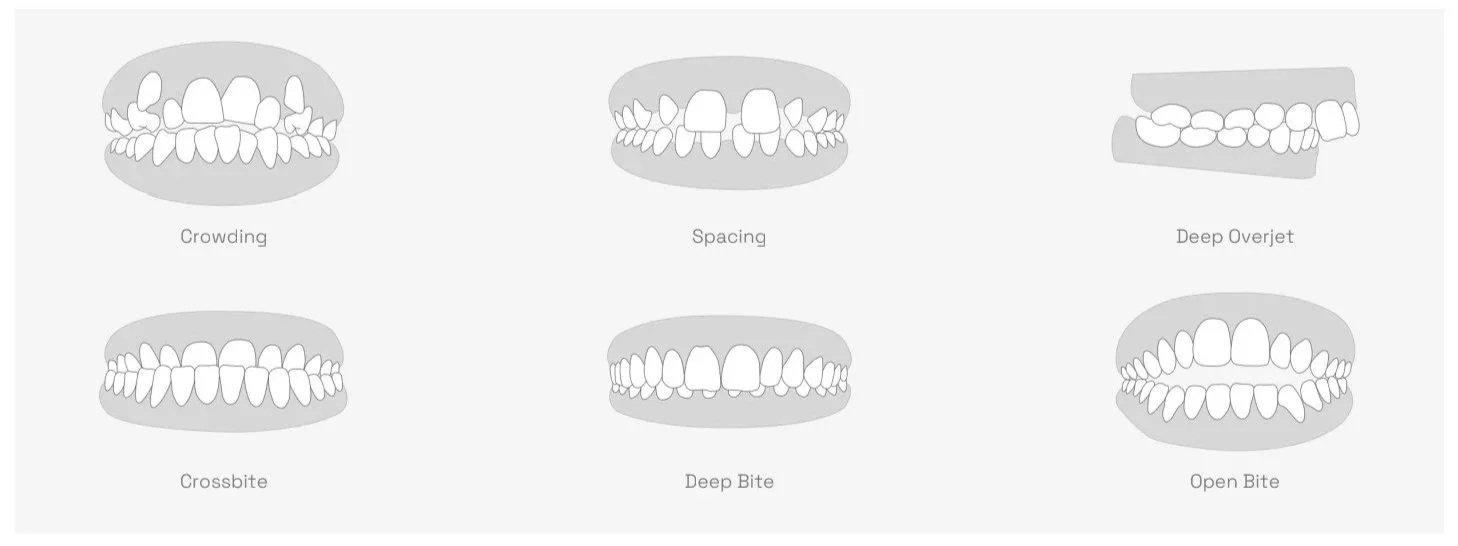
Crowding - Aligners apply gentle, sequenced pressure to slowly rotate and shift teeth apart until there's enough room along the arch. In more severe cases, a small amount of enamel is shaved between teeth (interproximal reduction) to create extra space before shifting begins.
Spacing - The reverse process: aligners nudge teeth toward each other in small increments, closing gaps evenly so no single tooth ends up doing all the work. Treatment usually tracks each tooth's movement individually to keep spacing balanced as it closes.
Deep overjet - Treatment typically moves the lower teeth forward and/or pulls the upper front teeth back, often using attachments (small tooth-colored bumps bonded to teeth) that give the aligner extra grip for this kind of horizontal movement. More severe cases may need elastics (rubber bands) between upper and lower aligners to add jaw-level correction.
Crossbite - Aligners tip or rotate the affected tooth (or teeth) back into proper position outside the opposing arch. This often needs attachments plus sometimes elastics, since crossbite correction requires more precise, targeted force than simple straightening.
Deep bite - Treatment focuses on slightly intruding (pushing up) the front teeth and/or extruding (pulling down) the back teeth to level out the bite, so the upper teeth stop overlapping the lower teeth so heavily. Bite ramps - small attached platforms on the back of the upper aligners — are commonly used to help open the bite gradually.
Open bite - The opposite goal: extrude (pull down) the front teeth so they lengthen enough to meet the opposing teeth when biting. This is often paired with elastics and sometimes a habit-correction step if thumb-sucking or tongue posture is a contributing cause.